

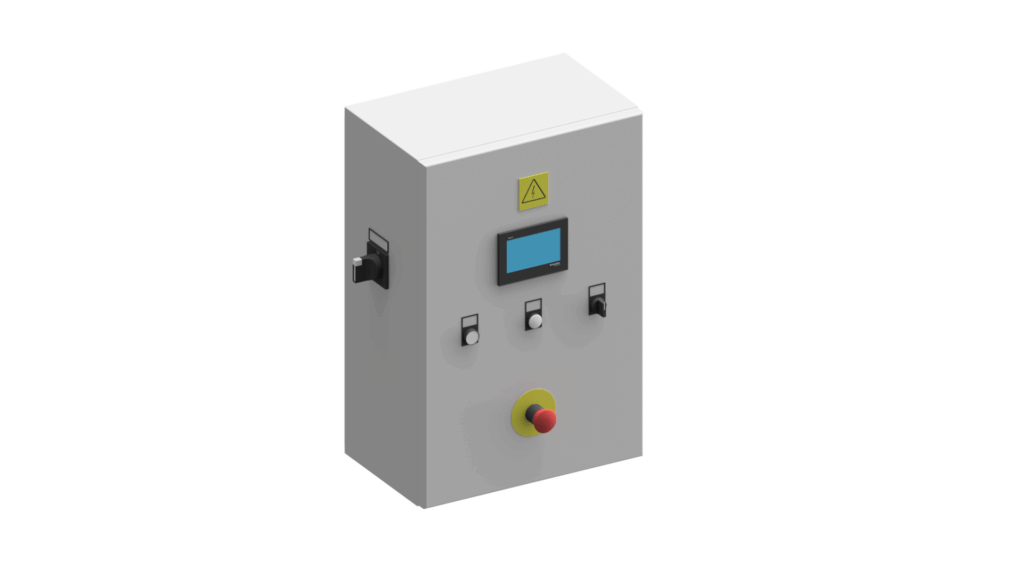
An extraction system controlled exclusively manually, with switches located at each fan and without any monitoring of operating parameters, is a standard from two decades ago. Today, such a system means fans operating at full capacity even when half of the workstations are idle, no indication of impending filter clogging, no fault logging, and no possibility of integration with other plant systems. Each of these shortcomings has a measurable cost: energy-related, maintenance-related, or production-related.
NAWARA designs and implements automation systems for extraction, filtration, and ventilation installations, from simple control cabinets with PLC and HMI to complete SCADA visualization systems integrated with the plant's IT infrastructure. Control cabinets are prefabricated in Poland, programmed, and tested before delivery to the site.
A fan operating at a constant speed under varying system load consumes constant power, regardless of whether 5 or 15 workstations are operating. A frequency inverter controlled by a signal from a pressure sensor or from the machine schedule reduces fan speed under lower load conditions. Energy savings in a typical production cycle amount to 25–45% compared to a constant-speed system.
Filter clogging, fan bearing damage, or the opening of an unsecured branch line. In a system without monitoring, these events become apparent only as a failure or as a result of exposure measurements during a labour inspection. An automation system equipped with a pressure switch, temperature sensors, and an event log enables service intervention before the problem turns into a failure.
Manual control of the start-up sequence (fan start order, delays between activations) is a source of errors, especially during staff changes or employee turnover. A PLC controller with a predefined sequence eliminates this class of problems and shortens system start-up time after downtime.
NAWARA prefabricates control cabinets based on Siemens SIMATIC, Allen-Bradley, and Schneider Electric platforms, depending on customer preferences or existing plant infrastructure. Design, wiring, programming, and functional testing are carried out entirely in Poland before delivery to the site. The cabinet is delivered to the installation location ready for commissioning.
Standard Controller Functions for an Extraction System:
We will select a solution tailored to the system's specifications, operating conditions, and technical requirements.
Contact UsA touchscreen HMI panel installed next to the system or on the door of the control cabinet provides the operator with a complete overview of the system status without the need to contact maintenance personnel.
For plants with multiple installations or reporting requirements, NAWARA implements SCADA systems enabling:
Many plants operate extraction systems with outdated automation: relay-based systems, without PLC controllers and without data recording. NAWARA performs control system modernizations involving replacement of the control cabinet or upgrading the existing one with PLC and HMI modules, without the need to modify the duct network or filtration equipment.
Integration with processing machines (acquiring machine start/stop signals for extraction damper control) is possible for most popular brands: Biesse, SCM, Homag, Weinig, Holzher, and others.
Can a NAWARA controller communicate with a CNC or processing machine?
Yes. Most modern processing machines have a relay or digital output indicating spindle or tool operation. The NAWARA controller receives this signal and automatically opens the extraction damper at the respective workstation, starts the fan, and closes the damper after the cycle is completed. This eliminates the need for the operator to switch the extraction system on manually.
How can an extraction system be protected against power failures?
The NAWARA controller can be equipped with a UPS power supply for the PLC module and HMI panel (backup time of 15–60 minutes), allowing the system to be safely shut down according to a predefined sequence and its status to be saved before power loss. After power is restored, the installation either starts automatically or waits for operator confirmation, depending on the configuration.
Can an extraction system be monitored and serviced remotely via the Internet?
Yes, provided the controller is equipped with a communication module, such as an industrial VPN router. NAWARA uses this solution for remote service support: a technician can check the condition of the installation, review alarm history, and in many cases diagnose a problem without visiting the site. The solution requires a dedicated LAN network for automation and approval from the plant’s IT department.