

A company manufacturing furniture, windows, or wooden components with a dozen or more processing machines has two options: several small filtration units installed at each machine or one central extraction system serving the entire production hall. The first solution appears simpler during the planning stage but proves more expensive to operate. Higher total energy consumption, multiple filter bag replacements in different units, lack of centralized monitoring, and limited expansion possibilities. Central dust collection eliminates these issues and is the appropriate solution for any facility above a certain production scale.
NAWARA designs and manufactures central extraction systems based on TOPAZ filters (stationary, negative-pressure) and RUBIN filters (modular, scalable) for production halls of various capacities, in both negative-pressure and positive-pressure configurations, with full automation and the possibility of integration with a SCADA system. TOPAZ(stacjonarne, podciśnieniowe) i RUBIN (modułowe, skalowalne) – dla hal o różnej kubaturze, w konfiguracji podciśnieniowej i nadciśnieniowej, z pełną automatyką i możliwością integracji z systemem SCADA.
A comparison of the two approaches in operational practice:
| Criterion | Local Units | Central System |
| Initial Investment | Lower | Higher |
| Energy Consumption | Higher (multiple motors) | Lower (one fan with frequency inverter) |
| Filter Bag Replacement | Multiple units, different schedules | One installation, one schedule |
| Monitoring | Difficult | One panel, full control |
| Expansion | Additional unit required for each machine | Connection to the existing network |
| Noise in Production Hall | Distributed, difficult to attenuate | Reduced – filter located outside the hall or acoustically insulated |
In a negative-pressure configuration, the extraction fan is located downstream of the filter. Material is transported through the ductwork under negative pressure, and the filter operates as the suction unit. This is the standard solution for most woodworking facilities.Bei der Unterdruckausführung befindet sich der saugende Ventilator hinter dem Filter. Das Material wird durch das Rohrnetz unter Unterdruck transportiert, der Filter arbeitet als Saugeinheit. Dies ist die Standardlösung für die meisten holzverarbeitenden Betriebe.
In a positive-pressure configuration, the fan is installed upstream of the filter. Material is transported under positive pressure. This solution is used for long ductwork routes (over 150 m) and for conveying high-density materials where negative pressure does not provide the required transport velocity.
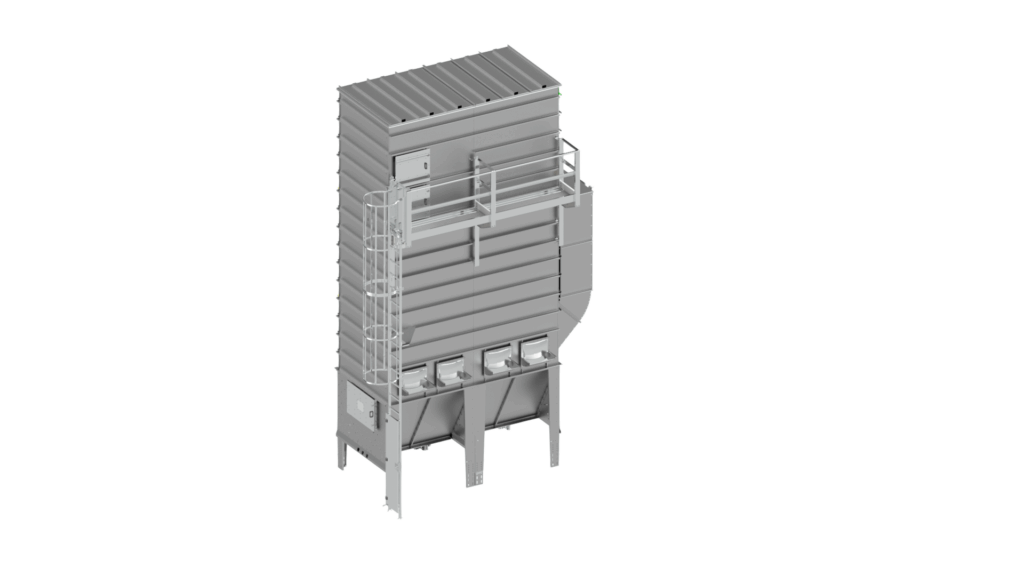
TOPAZ is a stationary dust extraction and filtration unit equipped with a high-performance fan, designed for systems serving multiple workstations simultaneously. It features a steel housing with automatic mechanical-pneumatic filter cleaning and a professional control system. The units are CE-marked and designed for the extraction of dry dust and wood chips. Residual dust emission does not exceed ≤0.2 mg/m³. ≤0,2 mg/m³.
RUBIN is a technologically advanced filter designed for effective extraction and filtration of dust and wood shavings in industrial facilities. Thanks to the innovative cleaning system for filter bags and the placement of the fan on the “clean” side of the filter, the unit can operate continuously 24 hours a day.
The system enables:
Silo filters offered by NAWARA are a reliable solution designed for dust extraction and air filtration in silos storing bulk materials. The units effectively remove dust generated during silo filling and emptying, protecting technological installations and the working environment.
Main Advantages:
We will select a solution tailored to the system's specifications, operating conditions, and technical requirements.
Contact UsA central extraction system equipped with a frequency inverter-controlled fan adjusts its performance according to the number of active workstations. When only half of the machines are operating, the fan consumes not half but approximately 30% of its nominal power due to the cubic relationship between power consumption and rotational speed. In three-shift operation, energy savings compared to a constant-speed system may exceed 40%.
Automatic cleaning in TOPAZ and RUBIN filters takes place during operation. Individual rows of filter bags are cleaned sequentially without interrupting airflow. Fans in RUBIN filters are individually selected according to customer requirements, while the reliable chain conveyor extraction system operates with low vibration and low noise levels.
NAWARA central systems are equipped as standard with a differential pressure switch with signalling, an operating hour counter, and an event log (alarms, shutdowns, parameter exceedances). Optional features include integration with the plant’s SCADA or BMS system, automatic reporting, and remote alarm notifications via SMS or e-mail.
From what factory size does a central extraction system become cost-effective?
The profitability threshold depends on the number of machines and their layout, but in practice almost every facility with at least 5–6 processing machines operating simultaneously achieves a lower total operating cost with a central system than with local units. NAWARA prepares a 10-year cost comparison for both solutions free of charge during the quotation stage.
Can a central extraction system be expanded after purchase?
Yes, provided a modular RUBIN system has been selected or the design includes a reserve fan capacity. NAWARA always designs installations with expansion capability in mind, allowing additional workstations to be connected without replacing the filtration unit. For TOPAZ systems, expansion involves adding a parallel filter unit or replacing the fan with a suitable model from a higher series (TOPAZ 2, 3 or 4).
How long does the installation of a central extraction system take?
How long does the installation of a central extraction system take? The installation time depends on the size of the system and the complexity of the ductwork network. A typical installation for a facility with 10–15 processing machines and a filtration unit located outside the building requires 2–4 weeks for installation, plus 1 week for commissioning and adjustment. NAWARA coordinates installation using its own personnel or in close cooperation with the customer's contractor.