

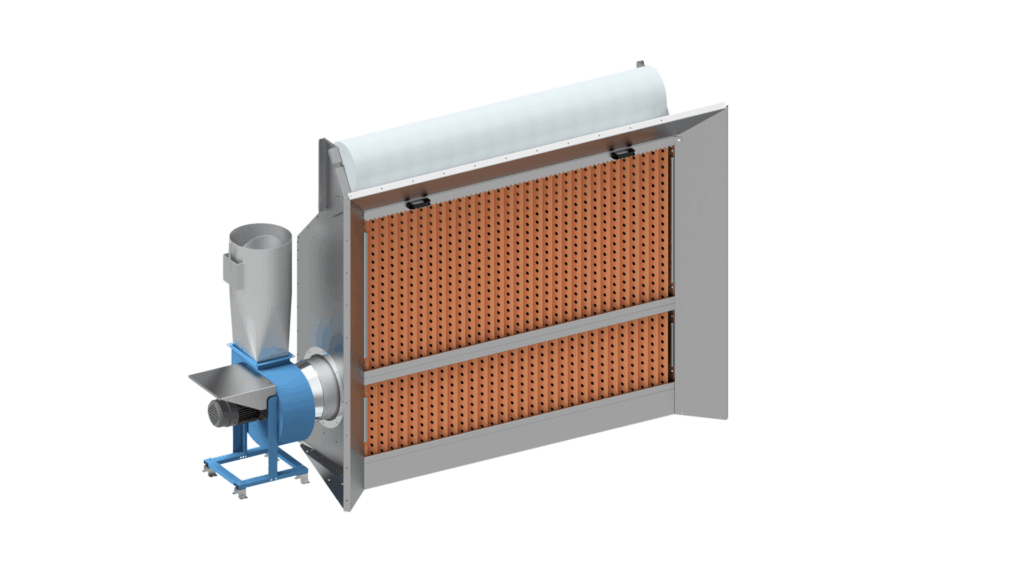
A spray booth without an efficient paint mist extraction system is one of the most costly oversights in a furniture manufacturing facility. Paint accumulating on booth walls, curtains, and lighting is not only an aesthetic issue – it is a fire hazard waiting for an ignition source. Excess paint suspended in the air represents a measurable material consumption cost. Employee exposure to isocyanate-containing paint mist may lead to occupational diseases recognized by insurance providers.
Paint mist extraction requires a different approach than wood dust extraction. Paint particles are sticky, vary in size depending on the spraying method, and may contain reactive components (hardeners, solvents) that alter filter properties during operation. NAWARA designs paint mist filtration systems taking these specific conditions into account, using either dry or wet filtration depending on the type of coating and environmental requirements.
Paint mist consists of a mixture of coarse paint droplets (above 100 μm, settling near the booth), fine mist (10–100 μm, transported by the airflow), and submicron particles and vapours (below 10 μm, capable of reaching the respiratory system). Each fraction requires a different separation method.
Water-based coatings - less flammable paint mist, but requiring higher air exchange rates and rapid drying; suitable for dry filtration using paper filters or baffle filter systems (e.g. AGAT spray walls with cardboard/baffle filters).
Solvent-based coatings - highly flammable mist with the presence of VOCs, requiring paint mist filtration combined with activated carbon adsorption of vapours; potential ATEX zones. NAWARA floor extraction systems can be equipped with activated carbon filters for VOC adsorption, with the possibility of regenerating undamaged activated carbon.
Powder coatings – require a booth with air recirculation and a centrifugal separator; no vapours are generated, but there is a dust explosion risk if filtration is inadequate.
UV coatings fast-curing coatings generating mist containing reactive acrylates; occupational exposure requirements are particularly strict (occupational exposure limits for acrylates below 1 mg/m³).
We will select a solution tailored to the system's specifications, operating conditions, and technical requirements.
Contact UsDry paint mist filtration is currently the dominant solution in newly built and modernized spray shops. NAWARA offers two key solutions in this area:
Advantages of Dry Systems Compared to Wet Systems
For very high paint mist volumes, coatings with a high solids content, or facilities requiring the highest level of fire protection, NAWARA designs water curtain spray walls. Paint particles are captured by the water curtain and settle in a sludge collection tank. These systems require water treatment equipment and disposal of paint sludge. wodne ściany lakiernicze. Cząstki lakieru wiązane są przez kurtynę wodną i opadają do zbiornika osadowego. Systemy wymagają układu uzdatniania wody i utylizacji szlamu lakierniczego.
AGAT spray walls a proven solution for companies of all sizes, appreciated in domestic and international markets for reliability and filtration efficiency. Their modular design enables expansion and conversion into a spray chamber or spray booth without replacing the unit.
Floor extraction systems individually designed according to the customer’s production profile and available in versions that do not require modifications to the building structure.
Ventilation and Air Supply Systems provide air parameters compliant with coating manufacturers’ requirements. The range includes supply-air systems with heat recovery, allowing recovery of up to 50% of the thermal energy removed from the spray shop.
Drying Tunnels designed for controlled drying of coated components, with a roller conveyor system ensuring continuous material flow. The interior is resistant to temperature and humidity, and equipped with LED lighting. Each tunnel is individually adapted to the required length, operating temperature, and type of transported material.
Retrofit solutions for existing spray booths for facilities with insufficient filtration performance or outdated wet systems, NAWARA designs modernization solutions including replacement of water curtains with dry filtration systems, installation of activated carbon modules, or replacement of fans with more efficient models.
How often should filters be replaced in an AGAT spray wall or floor extraction system?
Filter elements (cardboard or baffle filters) should be replaced depending on production intensity and the type of coating used. In a typical furniture manufacturing facility operating one or two shifts with water-based coatings, primary filters are usually replaced every 4–8 weeks, while final filters (Paint Stop media, EU5) are replaced every 3–6 months. NAWARA supplies replacement filter elements and can implement a replacement schedule with automatic ordering.
Does dry paint mist filtration (AGAT spray walls, floor extraction systems) comply with emission requirements?
Yes, provided that the appropriate filtration class and extraction performance are selected. For solvent-based coatings, it is essential to supplement paint mist filtration with VOC adsorption using activated carbon (available in NAWARA floor extraction systems) or thermal oxidation if annual solvent consumption exceeds 5 tonnes (IED Directive threshold). NAWARA provides the emission documentation required for KOBiZE reporting.
Can unused powder coating material be recovered from a filter in a NAWARA system?
Yes, in the case of single-colour powder coating applications. The NAWARA recirculation system collects powder from the bag filter and returns it to the spray gun hopper. When changing colours, a cleaning procedure for the booth and filter is required. NAWARA designs systems with easy access to the filter and automatic cleaning after the end of a production batch.