

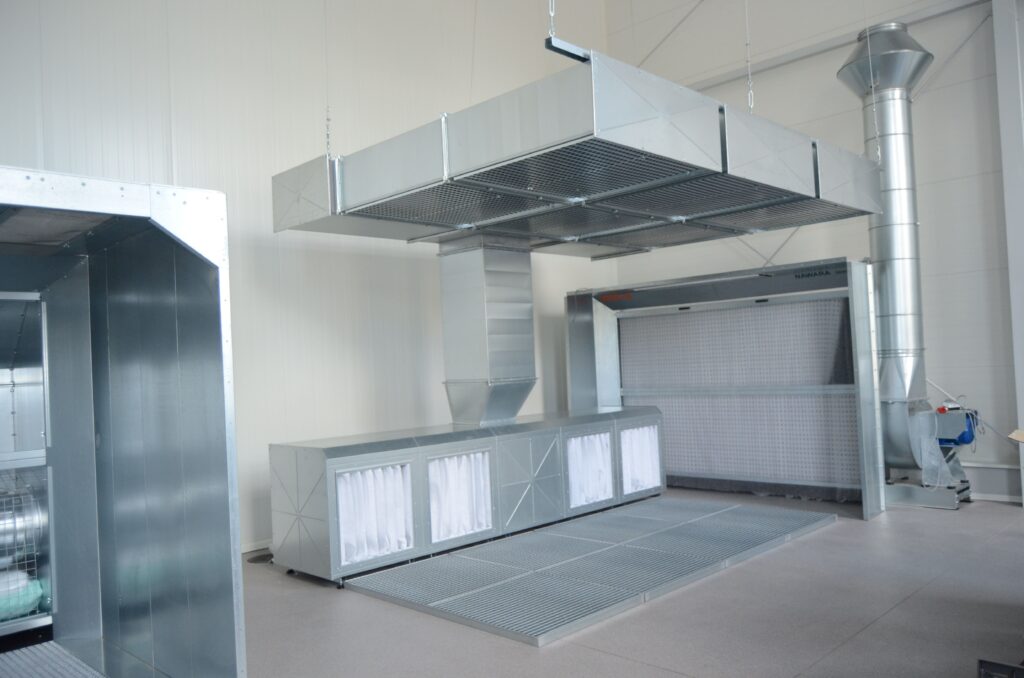
A sanding department generates dust that simultaneously poses a health hazard (Group 1 carcinogen), a fire hazard (LEL 30–60 g/m³), and a production risk (defects, downtime, and reduced machine life). One properly designed extraction system solves all three problems at a lower cost than addressing each separately.
NAWARA offers solutions for every production scale: from the compact CASTOR table, through MALACHIT extraction walls and KALCYT workstations, to multi-workstation OPAL and RODONIT tables, as well as high-pressure industrial dust collectors.
We will select a solution tailored to the system's specifications, operating conditions, and technical requirements.
Contact UsA sanding department in a small woodworking workshop and one in a factory producing 500 doors per day present two completely different engineering challenges. NAWARA does not sell standard catalogue products. Every installation is preceded by process analysis, airflow calculations, and duct network design. The customer receives a system designed specifically for their machinery, facility, and compliance requirements, whether it is a single CASTOR table (700 × 1,300 × 930 mm, 150 kg) for a small workshop or a multi-workstation OPAL configuration with work surfaces up to 3,000 × 1,000 mm and airflow requirements of 2,500 m³/h per workstation. The possibility of phased expansion – adding workstations, increasing fan capacity, or integrating new machinery – is planned already during the preliminary design stage. NAWARA floor sanding extraction systems are built from modular 1 × 1 m sections, allowing flexible adaptation to the layout of the facility and production profile, with the option of adding additional sections as required.
What filtration class is required when sanding MDF?
MDF dust contains free formaldehyde; therefore, the minimum recommended filtration class is M. For multi-shift operation, we recommend HEPA H13 filtration combined with an occupational exposure assessment. NAWARA high-pressure industrial dust collectors with integrated automation are specifically designed for such applications.
Does the installation require approval by a technical inspection authority?
Dust extraction installations do not require mandatory registration. However, compressed air vessels (including those used in RODONIT systems with automatic filter regeneration) and ATEX installations are subject to specific inspection and compliance requirements. NAWARA provides complete documentation and declarations of conformity.
How can heat losses be reduced?
Recirculation of filtered air is a standard feature of KALCYT workstations and floor extraction systems. For larger installations, heat recovery exchangers are used, recovering 60–85% of the energy from extracted air.