

Wood dust with a particle size below 500 μm forms an explosive atmosphere at the appropriate concentration. This is not a theoretical risk. Explosions in woodworking facilities occur several times each year, and potential ignition sources include sparks from tools, electrostatic discharge, or overheated bearings. A permanent extraction installation is not always feasible. During renovations, production line expansions, seasonal operations, or in facilities with frequently changing workstation layouts, a solution is required that can be relocated wherever a hazard exists.
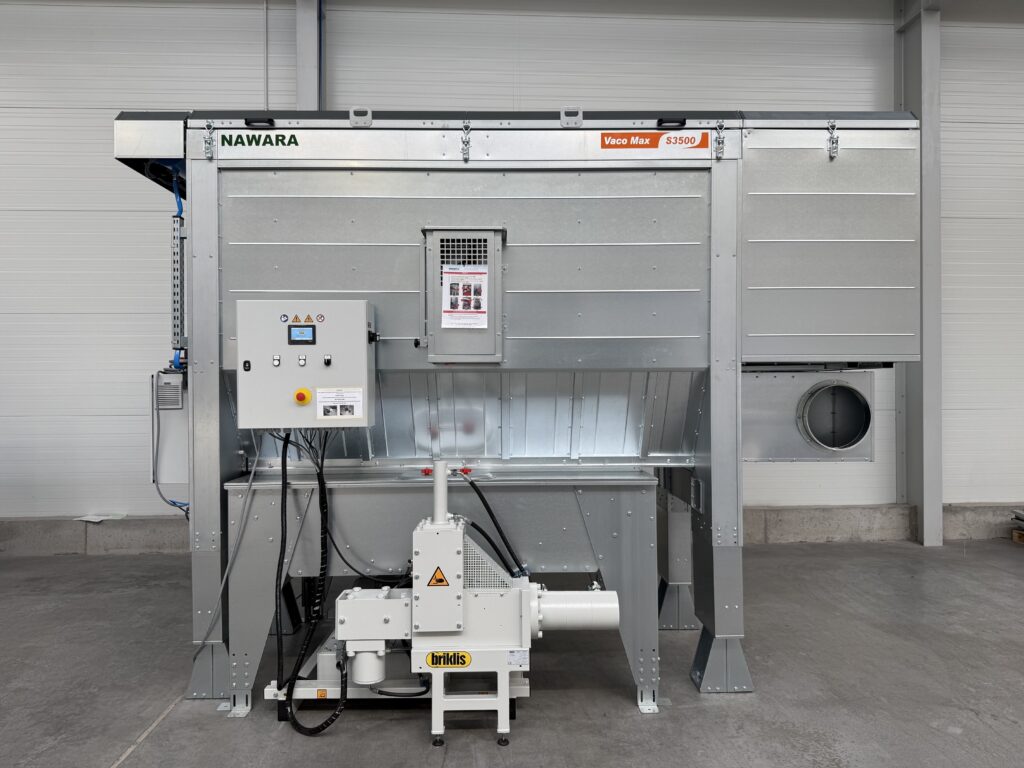
NAWARA mobile extraction systems from the VAKOMAX series, compliant with ATEX Directive 2014/34/EU, are designed for these situations. Four models (VAKOMAX 1000, 2000, 3000, and 3500) cover airflow capacities from 3,200 to 8,800 m³/h, serving applications from a single sanding workstation to multi-station MDF production lines.
The ATEX Directive classifies dust explosion hazard areas into three zones:
Most woodworking shops and MDF manufacturing facilities operate within Zone 21 or Zone 22. All VAKOMAX models are certified for operation in these zones.
A sanding or edge-banding workstation operates in different areas of the production hall → VAKOMAX 1000 or 2000 can be relocated within an hour without modifying the building infrastructure.
Modernization or expansion of a permanent extraction system while production must continue → VAKOMAX 3000 or 3500 can temporarily replace the fixed installation while maintaining full ATEX compliance.
A small production hall where a fixed system would be oversized → VAKOMAX 1000 (3,200 m³/h, 580 kg) is a compact solution suitable even for low-height rooms.
Additional protection during maintenance work → every VAKOMAX model is supplied with complete documentation ready for technical verification.
We will select a solution tailored to the system's specifications, operating conditions, and technical requirements.
Contact UsA mobile ATEX filter is not simply a dust collector mounted on wheels. All VAKOMAX models incorporate:
Each VAKOMAX model is supplied with an EC Declaration of Conformity, Ex marking, and manufacturer documentation required for explosion risk assessments. Customers receive a complete documentation package ready for implementation or inspection.
| Model | Inlet Diameter [mm] | filtration area [m2] | Airflow Capacity [m³/h] | Weight [kg] | Motor Power [kW] | ATEX Zone |
| VAKOMAX 1000 | 200 | 22 | 3 200 | 580 | 4 | 21/22 |
| VAKOMAX 2000 | 250 | 32 | 4 800 | 980 | 5,5 | 21/22 |
| VAKOMAX 3000 | 300 | 42 | 6 200 | 1 080 | 7,5 | 21/22 |
| VAKOMAX 3500 | 350 | 42 | 8 800 | 1 180 | 11 | 21/22 |
Filter cleaning in all models: mechanical/compressed-air regeneration.
ATEX certification is more than just a nameplate. For more than 20 years, NAWARA has been implementing ATEX projects, from small woodworking workshops using VAKOMAX 1000 units to large MDF production facilities operating VAKOMAX 3500 systems.
Service for the entire VAKOMAX range, including filter bag replacement, periodic inspections, and differential pressure sensor calibration, is performed by trained NAWARA technicians using original spare parts.
How can I determine whether my woodworking facility requires ATEX equipment?
The basis is an explosion risk assessment, which employers are required to carry out in accordance with applicable regulations. If wood materials are processed in the facility and dust is generated, particularly during sanding, edge banding, or milling operations, the assessment will almost always identify Zone 21 or Zone 22 areas. NAWARA assists with the interpretation of assessment results and the selection of the appropriate VAKOMAX model.
Can VAKOMAX be connected to an existing ducting system?
Yes, provided that the ductwork and connections meet antistatic requirements and are properly marked. NAWARA evaluates the compatibility of the existing infrastructure with the selected VAKOMAX model during the audit stage and, if required, supplies Ex-certified hoses and connections.
How often should filter bags be replaced?
The service life of conductive filter bags depends on operating intensity and dust characteristics. Under typical woodworking conditions (one- or two-shift operation), the expected service life ranges from 2 to 4 years. The large expansion chamber used in the VAKOMAX series can extend filter bag life to as much as 12 years compared to standard filtration systems. NAWARA supplies original replacement filter bags and maintains inspection documentation, facilitating occupational safety inspections and insurance audits.